There is no finer sound in the world than that of dice rolling on a smooth playmat. They did a study*; it’s just science. If you play Riot Quest, you’re already well acquainted with this sound, as nearly every Arena map for the game is produced on a neoprene playmat. (The only exception being the maps found in the starter boxes, and even they have neoprene versions available!)
If you’re just getting into Riot Quest or are looking to expand your collection a bit, let’s take a look at the maps currently available and break down the differences between each!
Thunderstone Fortress (Mayhem starter paper map / neoprene map)

Thunderhead Fortress, an old Crucible Guard facility that has fallen into ruin and disrepair after the apocalypse, was our first introduction to Arena maps in Riot Quest. The Fortress is a straightforward map, great for teaching new players the game or just for having a classic game of Riot Quest.
This map is also fantastic if you’re looking to test out the various combinations of Treasure decks, Bounty decks, expansions, and even Boss Fights. The Fortress provides a “control” to try these other forms of mayhem against, allowing you to learn the finer details about whatever new chaos you’ve introduced into your game before expanding to other maps.
Hullgrinder (neoprene map)
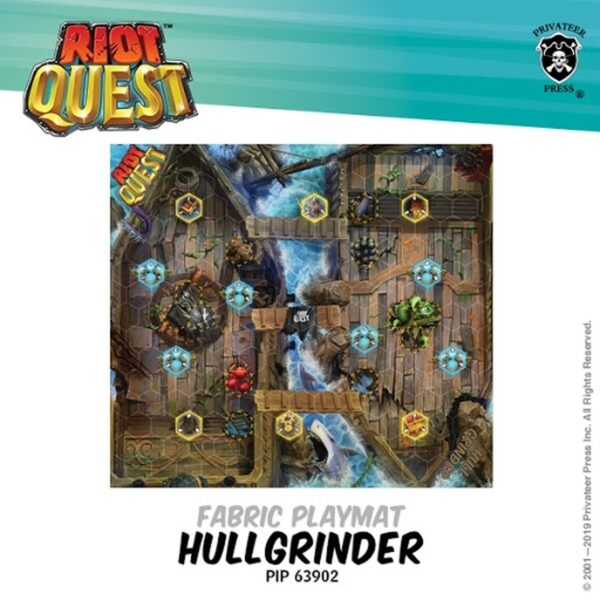
Hullgrinder is a pair of wrecked ships, caught in the middle of what looked to have been an intense boarding action, now slowly being eaten by the sea (and sea creatures). Hullgrinder really rewards Heroes with mobility or the ability to stand their ground. As the map is sectioned into two distinct ships that are connected by 1-hex wide gangplanks, you either need to be able to move between ships quickly to claim Bounties or be able to stand on a gangplank and stop the enemy from crossing over.
Temple of Concord (neoprene map)

The first “dungeon” map, Temple of Concord is made up of three distinct floors that are not connected by traditional hexes. Instead, each floor has stairs or ladders that lead from one specific hex to another specific hex on a different floor. This creates a sense of compartmentalized chaos, and it rewards players who can move the right Hero to the right floor to participate in the right brawl at the right time.
Heroes that can teleport, such as Chuck Dogwood, or gear that allows you to teleport, such as the Translocator, are extremely potent on this map. Just as on Hullgrinder, a Hero that can stand their ground also has loads of value in the Temple, as they can stand on a level’s entryway and try to prevent their enemies from crossing onto their floor.
Castle of the Dark Prince (Wintertime Wasteland starter paper map / neoprene map)
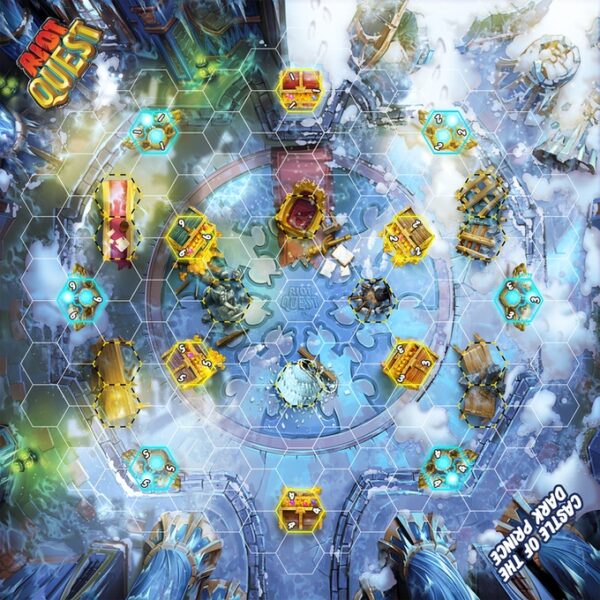
The Castle of the Dark Prince is a cursed, frozen old castle, thought to once belong to a dark prince of Khador. This map actually has two versions! The starter paper map is the vanilla version, and just like Thunderstone Fortress, it is a straightforward map great for learning the game. All the aspects that apply to the Fortress apply here as well, though the layout of the map is unique from the Fortress, so you do get a slightly different experience.
The neoprene version of the map introduces trap door hexes, which Heroes can utilize to traverse the dungeons beneath the Castle. When you play with the neoprene map, you can choose to play with “Trap Doors Off,” which means you are playing the normal starter experience. But if you play with “Trap Doors On,” then all of the trap door hexes are an opportunity for a Hero to run from one side of the map to another…if they’re lucky enough to not fall into a trap in the dungeon below and end up in the Cooler!
Of course, we’ve got loads more maps in development as we speak, one of which you might be seeing sooner than you think! For now, if you’re looking to pick up your own neoprene map for Riot Quest, make sure to check out the online store, and choose whichever adventure suits you best!
*There was no study.