Today, we’re going to be talking about something I know everyone holds near and dear to their hearts: math! I have had requests I would never have expected, from more than a few people, to talk dice, of all things. Specifically, Strike Dice. So, before we begin, I want you to know: I’m not a mathematician by any means. That being said, I do have some formal statistics training and a dad who would ask my siblings and me math problems on road trips for fun. Yup, we’re a weird family.
Before we get to Strike Dice, let’s quickly talk about the basic six-sided die (D6). You probably know most of this, but let’s refresh. Rolling 1D6 produces what is called a uniform distribution—each number 1 through 6 has an equal chance of occurring. Rolling 2D6 produces a normal distribution, which looks like this:
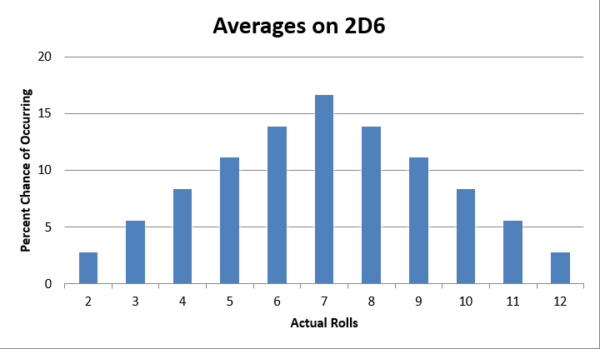
A normal distribution like this is perfectly symmetrical. To explain it another way, a 2D6 roll can have the results 2 through 12, with each set of the lowest and highest numbers having the same odds: 2 and 12 have the same chances, each occurring on average once in every 36 rolls, 3 and 11 have the same chances, each occurring on average twice in every 36 rolls, and so on all the way until 7, which is the apex, occurring on average six times in every 36 rolls. The same general principle occurs when you roll even more dice, except the normal distribution gets squashed down for each die you add. That is to say, you have a progressively lower chance of rolling the extremes (all 6s or all 1s) and a higher chance of rolling near the middle of the curve (a total of 10 and 11 in the case of 3D6).
So, when you are playing a game, the amount of dice rolls you make may seem like a lot, but from a statistics standpoint, it’s a fairly small sample size. If you were to sit down and roll 2D6 and chart the results, it would take you a good while before you saw what looked like a normal distribution. When you are playing a game, you shouldn’t expect to roll anything that perfectly resembles a normal distribution. Sets of “hot” or “cold” rolls occur commonly. In a long enough timeline, the normal distribution will appear, but it might take many games. What that means in your games is, the more important the roll, the less you should rely on averages, and when making a large set of rolls (say, an entire unit shooting), you should expect to spike or whiff hard on some of those rolls.
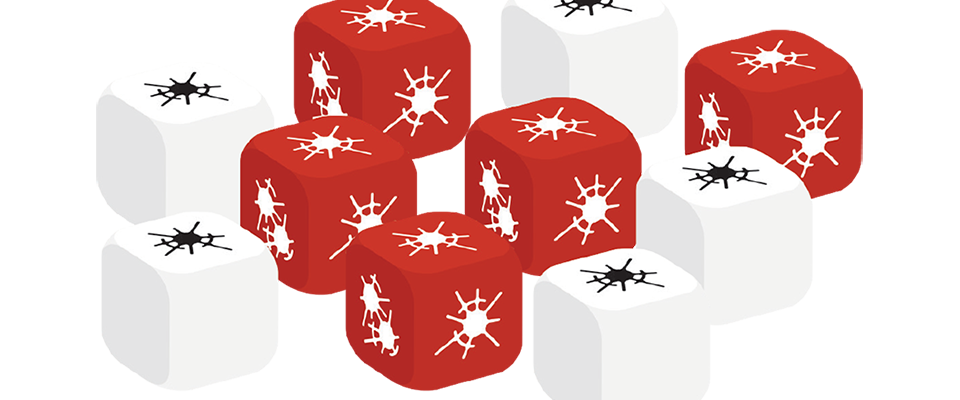
With D6 out of the way, that brings us to Strike Dice. Three of our games (including Warcaster!) primarily use Strike Dice. There are three different types: Action, Boost, and Power. And Strike Dice have three kinds of results: strikes, one super strike (that’s two strikes at the same time), and blanks. Action Dice have two single strikes and three blanks, Boost Dice have three single strikes and two blanks, and Power Dice have four single strikes and one blank. Rolling multiple Action and/or Boost Dice creates what is called a skewed distribution.
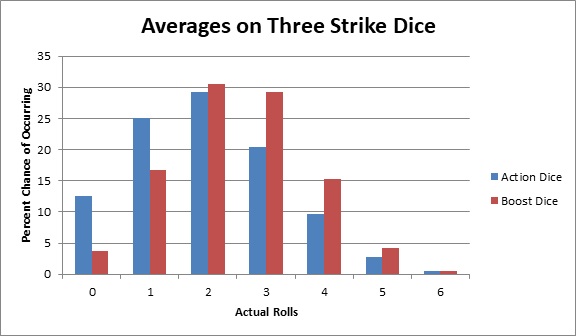
As you can see, both Action and Boost Dice skew oddly to the left. However, the more dice you add, the more “normal” the distribution becomes. The following table is rolling five Action Dice and five Boost Dice together:
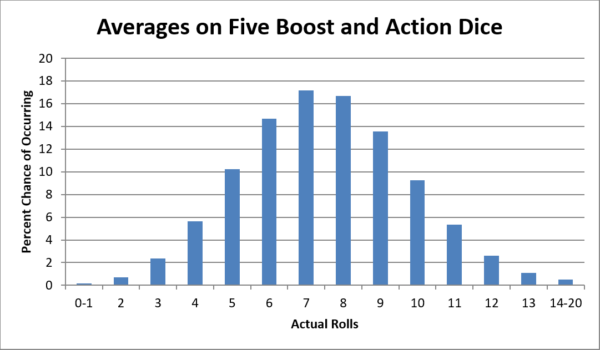
In this table, the results still skew slightly, but it is much less obvious. Do note that I combined some results at the start and end, since the numbers start to become ridiculously small near the extremes on large sets of Strike Dice.
Finally Power Dice are fairly basic odds by comparison to Action and Boost Dice, since there is the same chance of rolling a blank as a super strike. They end up with a normal distribution similar to D6s.
Now that we have the big picture of how Strike Dice work, let’s focus down a bit. When looking at each type of Strike Die, it’s best to consider their average strikes from each roll. Each Action Die rolls on average 0.67 (2/3rds) of a strike each roll, each Boost Die averages .83 (5/6ths) of a strike, and each Power Die gets 1 strike. Those might seem like weird numbers; how can someone roll a portion of a strike? However, this is considering the average result, not the real result, which allows you to add up the average of a mixed set of Strike Dice quickly. So, for every Action Die in a roll, you add 0.67, Boost Die adds 0.83, and Power Die 1, the total is the average amount of strikes that combined roll is likely to get. For example, four Action Dice (2.65), three Boost Dice (2.5), and two Power Dice (2) rolls on-average 7.15 strikes, but since you can’t really roll 0.15 of a strike, you ignore the decimal. Thus, seven strikes.
I’m sure many of you are cringing at having to do that math constantly. So, for a quick and dirty alternative, simply add ½ a strike per Action or Boost Die, and 1 per Power Die. This won’t get you the real average; however, it will let you quickly consider your chances without having to take out a calculator. If you use this method and your total is equal to your opponent’s defense, then you know you have a fairly good chance (usually above 70%) of hitting. When a roll is super important for me (for example, getting the last power attack off on a monster to kill it or scoring several victory points in Riot Quest), I usually aim for one or two higher than the number I actually need to hit. That being said, I’m a fairly conservative gambler, so feel free to play with the odds to consider other goal numbers.
All right, everyone, breathe a sigh of relief because we have successfully talked about dice math. Now let’s talk a bit about some reasons to use Strike Dice over traditional D6s. First, let’s talk Riot Quest and Monsterpocalypse, since those games use dice much differently than the way Warcaster does.
Both Riot Quest and Monsterpocalypse use Action Dice, which have the worst average strikes per roll. Monsterpocalypse forces you to accomplish certain things to get access to better dice, be that destroying buildings and units for Power Dice or moving units into special formations for Boost Dice. In Riot Quest, Power Dice also often come with things that need to be accomplished, such as moving before attacking for a Fighter or equipping Gear cards. In this way, both Action Dice and Power Dice become a rare resource, with Boost Dice acting as background bonuses to even out the average strikes. In both games, you don’t want to roll more than one Action Die unless you can’t avoid it, because those Action Dice can be used to get access to more powerful Strike Dice rolls later. Sometimes you have to roll Action Dice, either because it’s the last roll of the game and just because you want to increase your odds as much as possible or because you have very critical rolls and can’t roll anymore Boost or Power Dice. Thus, the reason for using Strike Dice in these two games becomes clear: the dice act as the back-bone of both systems, simultaneously as coveted resources and for adding lot of space to balance each model because each die rolls a different amount of average strikes.
Warcaster uses Strike Dice for very different reasons: simplicity and clarity. Since almost all stats in Warcaster are an amount of Action Dice you roll, you end up rolling quite a few dice at once. For example, if are shooting with a RAT 4 model that is charged with one Arc, and you’re targeting a DEF 3 model with cover, both you and your opponent will be rolling five dice—four Action and one Power for your attacking model and three Action and two Power for your opponent’s model. Unless you are a total nerd, it’s not much fun to add up 5D6 each time you roll, but adding up the total strikes on a set of Strike Dice is much easier. It might seem like an arbitrary reason to use Strike Dice, but when making games, you don’t want to force your players to sit there and constantly do math. Unless you’re a geek like me, you probably don’t like talking about and doing math constantly…
Welp, that’s it, and I think we can all agree on one thing: I’m a big nerd. But hey, being a nerd is awesome sauce!