
Welcome back to our series of developer diary articles about The Undercity, the newest board game from Privateer Press.
Before we began real work on the rules for how the game would play or the scenarios that would form the overall campaign, we needed to decide what the characters in the game would look like.
Since we had decided the game should serve as an intro to the setting and to the other rule sets of the Iron Kingdoms, I had a great place to start. Knowing that everything would be based on rolling dice, adding a stat, and comparing against a target number, I could borrow a lot of the numbers that already existed in our other games.
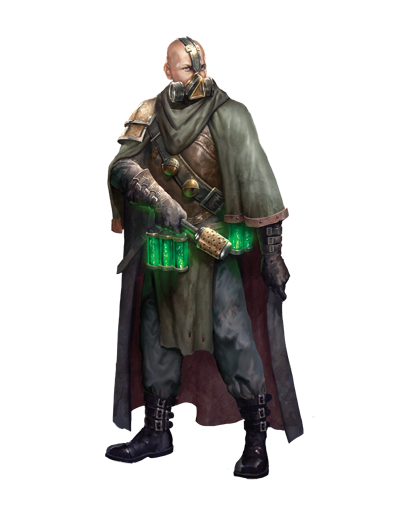
With this in mind, I pulled out the character sheets for the Black River Irregular characters as they appeared in the first Iron Kingdoms RPG adventure, Fools Rush In. I had no trouble translating Milo Boggs or Gardek Stonebrow into the rough framework I had established for the heroes in the new game, but the other two, Colbie Sterling and Eilish Garrity, presented some challenges.
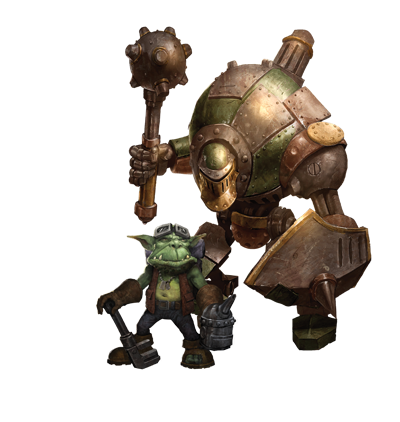
Colbie wouldn’t have been a problem on her own, but her buddy Doorstop the steamjack made things a bit more complicated. In a cooperative game, it’s important that no player feels that he or she isn’t an important part of the team. As a capable combat character teamed with what may be the toughest and most hard-hitting member of the team, Colbie could easily have been the “best” hero in the party. I sat down with the rest of the development team to brainstorm a few solutions. In the end, the two options that seemed most viable were to make Doorstop itself a playable character or to replace Colbie with someone who could be a more balanced “other half” of Doorstop duo.
In every game we make, we strive to express the setting as envisioned, both in the fiction that accompanies the rules and in the rules themselves. Making Doorstop a character that played independently from a ’jack marshal or warcaster could have worked, but it wouldn’t have reflected the fact that although a steamjack in the Iron Kingdoms is semi-autonomous, it reaches its full potential only when directed by a character trained to operate it. This made creating a new character the best option—and I already had an idea for who that should be.
I’ve always liked the gobbers of the Iron Kingdoms because, unlike the goblins that terrorize many fantasy worlds, gobbers have found a way to coexist with their neighbors. Also, when you’re looking for a character that won’t outshine the combat prowess of other heroes in the party, it’s hard to go wrong with a gobber. This gave birth to Pog (or Poggolagulobaltulon, if you’re not into the whole brevity thing).
Eilish was an entirely different issue. As the arcane character on the BRI team, he represented the aspect of the rules that was still the most undecided. We knew how melee attacks and ranged attacks would work, but a system to represent all the things that can be done magically in the setting would require a lot more streamlining. Without the basics of the game completely locked in, a lot of questions needed answers before Eilish could be figured out.
At that same time, we were discussing the optimum number of heroes for the game, and we eventually agreed that four would work best. We were also talking about other aspects of the setting that we wanted to include in the game. This led to conversations about whether Eilish should represent magic in the core game or if he would make a better arcane character for an expansion.
Magic in the Iron Kingdoms takes many forms, and one of the most distinctive is the gun mage tradition. The more we talked about it, the more we agreed that a gun mage should be the fourth character. Luckily, there was already a gun mage involved with the Black River Irregulars, albeit as an adversary. In the novella Murder in Corvis, the BRI tangles with the deadly Canice Gormleigh. We decided that along with the addition of Pog, it would be interesting if The Undercity also showed that Colbie was expanding the roster of her merc company. This gave us an easy way to bring Canice into the game and settle the question of who the heroes would be.
Next time I’ll talk a bit about the mechanics for representing the four heroes in the game and the process we used to develop them.